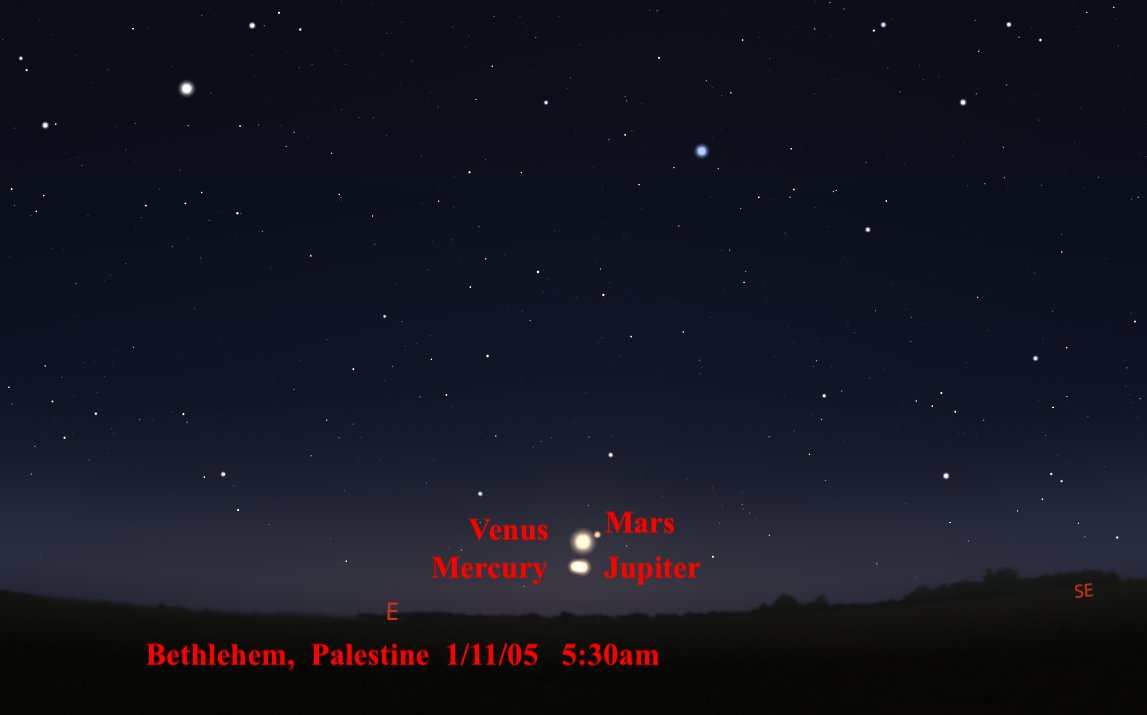
The proposed sequence begins on 27 August 3 BC, when three planets appeared close together ( with the star Regulus) in the sky. A second similar conjunction is suggested for 26 August 2 BC (probably the date of Jesus' birth). Then, on 5 November 1 AD, the most remarkable event may have occurred: the four planets came together in an especially tight grouping (Photo), appearing almost like one bright point or one concentrated area of the sky.
This idea is important because ancient people paid close attention to the movements of planets. In the ancient world, planets were not seen only as physical objects. They were also understood as signs connected with kings, nations, and important historical events. A repeated conjunction, especially one involving several planets, could have been interpreted as a powerful message.
Could such an unusual event be connected with the Gospel story of the Star of Bethlehem? This remains only a hypothesis. The Gospel of Matthew does not describe the star in modern astronomical language. It simply says that the Magi saw a sign “at its rising” and followed its meaning.
However, the idea is fascinating. If these conjunctions really formed a visible and repeated pattern in the sky, they may have attracted the attention of skilled observers from the East. The final and tightest conjunction, on 5 November 1 AD, could have been seen as the climax of a heavenly sign that had developed over several years.
This hypothesis does not prove the identity of the Star of Bethlehem, but it offers an interesting bridge between astronomy, history, and the Gospel narrative. It invites us to look again at the ancient sky and ask: could the heavens have recorded a sign that people of that time understood better than we do today?